
The AI Maturity Continuum: Navigating Digital Transformation Through Dr. Stephen Covey’s – “The 7 Habits of Highly Effective People”
Over my three decades as an Enterprise Architect, I have always believed that our most critical skill isn’t mastering the latest programming language, cloud platform, or framework. It is the ability to see the “big picture”—to connect the disparate dots of business vision, human behavior, and emerging technology into a unified, coherent whole.
Right now, we are navigating the most disruptive technology wave of our careers: the Artificial Intelligence revolution.
Under relentless pressure to deliver instant market results, many organizations are panicking. They are rushing brittle AI prototypes to production, hard-coding applications to volatile third-party APIs, and neglecting their underlying data structures. They are accumulating a mountain of technical debt that will take years to pay off.
How do we restore sanity and structure to this gold rush?
I have found that when technology changes at a dizzying velocity, we must anchor our strategy to timeless, unchanging principles. Back in 1993, I was fortunate enough to be personally coached and mentored by Dr. Stephen R. Covey. His teachings shaped my moral compass and my architectural philosophy forever.
By mapping the AI transformation journey to Dr. Covey’s classic Maturity Continuum, we can visualize a clear path from reactive technological chaos to strategic, sustainable business leadership.
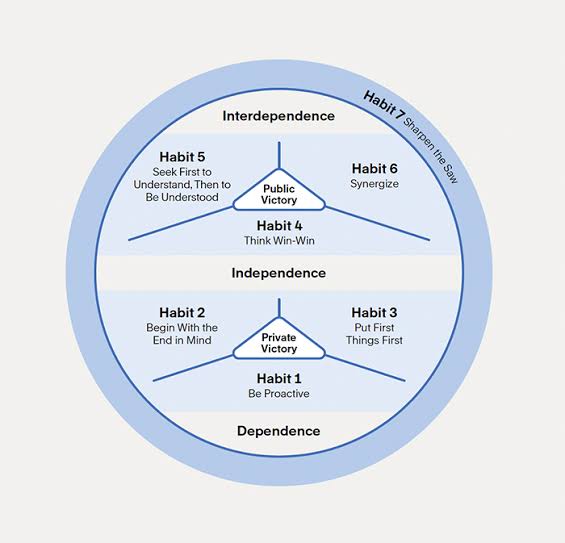
Dr. Stephen Covey’s Maturity Continuum: The ultimate framework for architectural and organizational maturity.. Source: FranklinCovey
The Current State: Technological Dependence
At the bottom of the Maturity Continuum lies Dependence—the paradigm of “You take care of me.”
Sadly, this is where most enterprises reside in their current AI journey. They are entirely dependent on external AI vendors. They react to every single vendor product announcement with panic, scrambling to rewrite their software around the “hot new model” of the month.
They build tightly coupled integrations, essentially locking their corporate intellectual property and workflows into a single vendor’s black-box ecosystem. This reactive posture is the definition of technological dependence. To break free, we must strive for the Private Victory and claim our architectural independence.
Phase 1: The Private Victory (Achieving Independence)
Independence is the paradigm of “I am self-reliant.” In enterprise terms, it means the organization controls its own technological destiny, regardless of which external models rise or fall.
Habit 1: Be Proactive
A reactive organization waits to see what security breaches or compliance issues occur before scrambling to write a policy. A Proactive architecture establishes strong, automated data classification frameworks, security guardrails, and data loss prevention (DLP) protocols before a single model is integrated. It focuses on the circle of influence—the enterprise’s own data estate—rather than stressing over the shifting, unpredictable external AI landscape.
Habit 2: Begin with the End in Mind
This is the single most critical habit for a modern architect. The “end” is not simply shipping an AI chat interface this quarter; the end is building a modular, resilient enterprise that stands the test of time.
Practicing Habit 2 means designing a model-agnostic architecture. By building an abstraction layer (or “wrapper”) around AI models, you ensure that the underlying enterprise applications remain decoupled from any single API. When a faster, cheaper, or more secure model emerges next month, you can swap it out instantly behind the scenes without rewriting a single line of core business code.
Habit 3: Put First Things First
In the AI era, there is a constant, loud demand for flashy, superficial prototypes. But a principle-centered architect knows that AI is only as strong as the data that feeds it.
“No amount of AI magic can fix a foundation built on unstructured, dirty, and siloed data.”
Putting first things first means saying “no” to premature, cosmetic applications and prioritizing the unglamorous, foundational work: building clean data estates, robust metadata structures, and highly secure data pipelines.
Phase 2: The Public Victory (Achieving Interdependence)
Once an organization achieves a stable, independent architectural foundation, it can rise to Interdependence—the paradigm of “We can cooperate to achieve something greater than any of us could do alone.”
This is where true business-technology alignment happens, transforming AI from a developer’s tool into an enterprise multiplier.
Habit 4: Think Win-Win
Historically, IT Security and Business Units have had an adversarial relationship. Business wants to move fast and bypass rigid procurement cycles (creating “Shadow AI”), while Security acts as the heavy-handed “Department of No.” We must architect a Win-Win framework. By rapidly provisioning secure, corporate-walled sandboxes and enterprise API gateways, we give the business the speed they crave while guaranteeing the data protection and compliance that security demands.
Habit 5: Seek First to Understand, Then to Be Understood
Technologists are famous for pushing complex, high-tech features for business users’ consumption without truly understanding their day-to-day pain points and readiness level. To build meaningful AI solutions, we must first step out of our technical silos. We must sit with the business users, deeply listen to their operational friction, and understand their workflows in their terms. Only then can we translate advanced technical capabilities into simple, high-value “business solutions.”
Habit 6: Synergize
True synergy in the modern era is the harmonious integration of human domain expertise and machine intelligence—what I call Human-in-the-Loop Architecture. Synergy is not about using AI to replace human employees. Rather, it is about designing collaborative systems where the cognitive strengths of a seasoned professional are supercharged by the processing power of a secure, well-architected AI system. The output of this combined system is exponentially greater than either could achieve alone.
Phase 3: Continuous Renewal
Habit 7: Sharpen the Saw
The final habit is about preservation and continuous improvement. In an enterprise context, “sharpening the saw” means dedicating time and resources to evaluate our systems for technical debt, optimize infrastructure costs, audit model drift, and continuously refine our data estates. It is the commitment to step back from the daily grind of feature deployment to ensure our architectural engine continues to run at peak efficiency.
Connecting the Dots
As architects and business leaders, the choices we make today will dictate our organization’s stability for the next decade. If we chase the fleeting hype of individual models, we will build fragile, dependent systems.
But if we anchor our AI transformation to the timeless principles of the Maturity Continuum, we build an architecture of trust, resilience, and ultimate business alignment.
Let’s Discuss: Where does your organization currently sit on the AI Maturity Continuum? Are you still navigating the risks of “Dependence” on external vendors, or have you begun building an independent, model-agnostic foundation?
To explore further strategic insights on navigating enterprise cloud and AI complexity, visit the full series at meghastuti.com.