
The Efficiency Trap: Is Your Risk Framework “Effective” or Just “Fast”?
A Principal’s Guide to Value-Based Risk Prioritization.
In my 40 years of architectural oversight, I have seen many organizations fall into the “Efficiency Trap.” They spend millions making their risk assessments faster and more automated, but they fail to ask if they are assessing the right risks in the first place.
As Dr. Stephen Covey famously noted in The 7 Habits of Highly Effective People, there is no use being “efficient” if what you are doing lacks meaning or purpose. In Enterprise Architecture, this means doing the right things right.
Compliance vs. Resilience
Many organizations rely on an ad-hoc or purely compliance-based approach to risk. While compliance is a legal mandate, it is often a “floor,” not a “ceiling.” A truly effective strategy is risk-based—it prioritizes assets based on their actual value to the business, not just a checkbox on an auditor’s list.
To build an effective prioritization framework, we must look at the intersection of two critical pillars:
1. Information (Data) Asset Classification
Before you can protect an asset, you must determine its relative sensitivity and criticality.
- Criticality: The business impact due to the loss of an asset (Availability).
- Sensitivity: The impact on the brand and legal standing due to unauthorized disclosure (Confidentiality).
- The Formula:
Sensitivity + Criticality = Business Value
2. Critical Business Functions (BIA)
What is the actual impact of an interruption to your operations? Through a Business Impact Analysis (BIA), we identify vulnerabilities and develop strategies for minimizing risk to the functions that keep the lights on. This is the heart of Business Continuity Planning (BCP).
The Intersection of Priority
Imagine two sets: one representing your most sensitive Data and the other representing your most critical Business Functions.
The “Intersection”—where your most sensitive data lives within your most critical functions—is your Tier 1 Priority. This is where your “scarce business dollars” must be spent first. Only after the intersection is hardened should we address the wider union of the two sets.
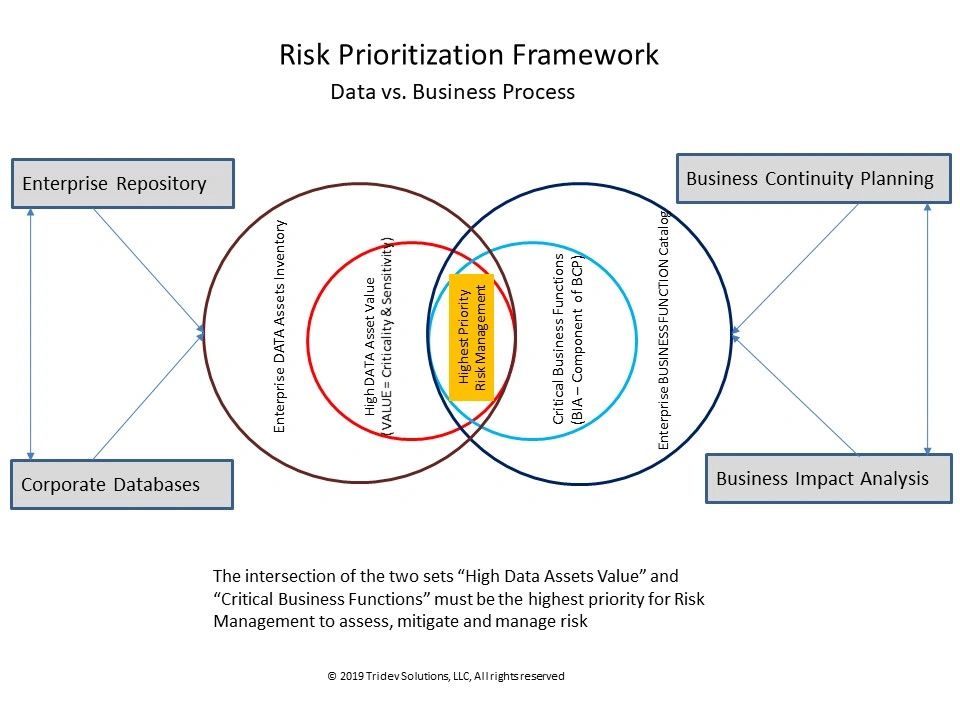
“Put First Things First” – Habit 3 (The 7 Habits of Highly Effective People by Stephen R Covey)
For any questions, please feel free to contact us ….
The Principal’s Perspective: Habit 3
“Put First Things First.” In an era of infinite threats and finite budgets, a Principal Architect’s role is to provide the “Pattern Recognition” necessary to see this intersection clearly. We must have the discipline to secure the core before we chase the perimeter.